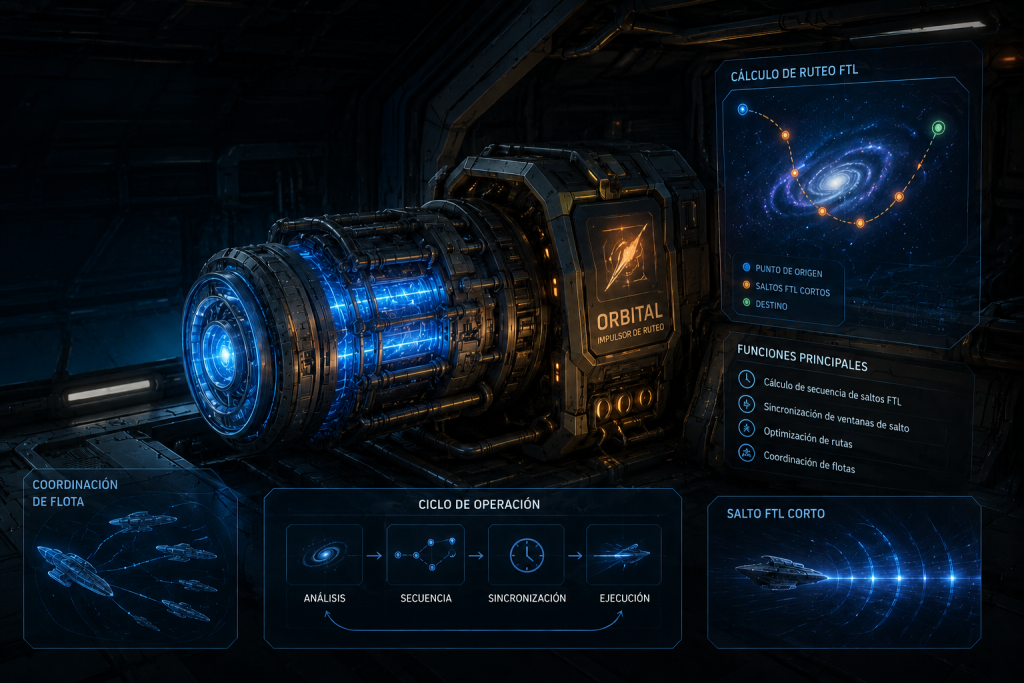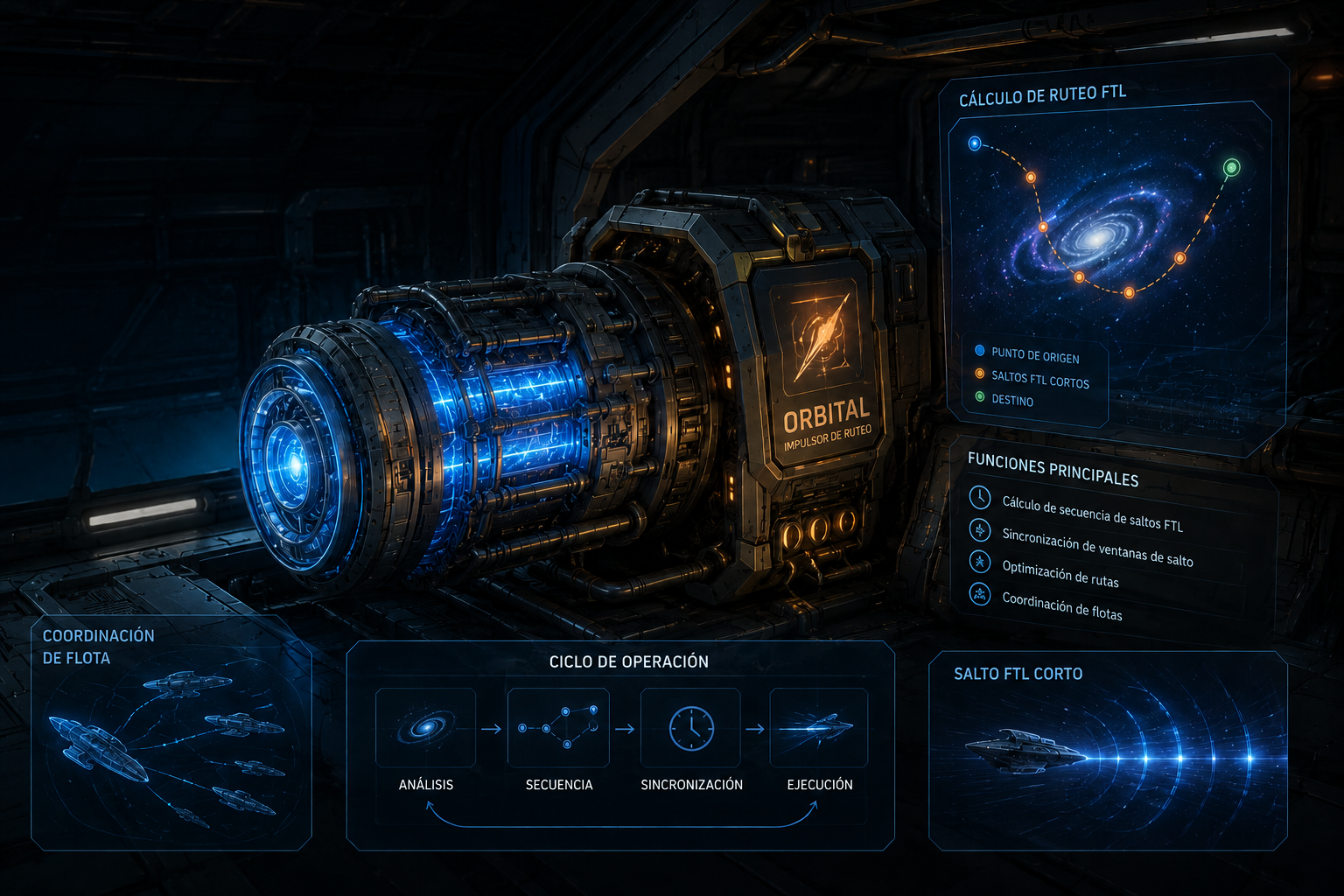
Prologue — The Echo in Deep Space
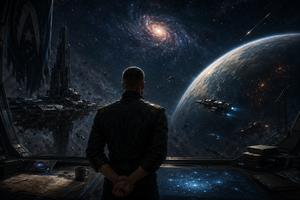
I did not expect to wake up.
The last thing I remember is the red light, and the choice, and then the weight of a station coming apart around me. Destroy. I pulled the trigger on synthetic life across the galaxy — the Reapers, yes, but the geth too, and EDI (Enhanced Defense Intelligence, the Normandy’s self-aware shipboard intelligence), and every mass relay that had ever stitched the stars together. I saved everyone by cutting the galaxy’s tendons. Then I took a breath under the rubble that I had no right to take.
They gave me a medal in the shape of a court-martial.
The Council’s reasoning was not wrong, exactly — it was just not the whole of it. I had annihilated an entire order of life to win a war. I had also burned the relays, and with them the roads under every economy, every culture, every way of life the Citadel races had built across thousands of years. To the Alliance I was the hero who had ended the Reapers. To nearly everyone else I was the human who had broken the galaxy to do it — and humanity had been getting too big for its armor for thirty years. Someone had to answer, and in choosing me there was a message worth sending, and the Council sent it: you are not in charge anymore. You are not welcome. So they shipped their savior to a cell on Palaven, under turian guard, and called it justice. The bitter arithmetic is that it
was justice — both truths can coexist.
The galaxy, meanwhile, got on with the slow, relay-less business of surviving. It pulled inward.
Whole populations abandoned the far systems and clustered around a handful of bright ones — Thessia, Palaven, Sol — worlds with shipyards and soil and enough fleet left to matter, packed close so that help was days away instead of never. Every cluster an island; every fleet crawling; and out past the light of those few fires, the stragglers — colonies too far, too stubborn, or too poor to come in.
And the relays took the talk with them. The buoys that carried faster-than-light comms died with the network that fed them, and a message now crossed the stars the way mail once crossed old Earth — carried, hand to hand, one jump at a time, by bold captains playing the role of Pony Express riders between neighboring stars. News arrived stale or not at all. The galaxy had not only gone slow. It had gone quiet.
Here is the part nobody knew, the part I learned when the cell door opened and the Council walked back in with their faces gray. It began with that quiet deepening: the stragglers out on the rim going dark, one by one — no distress calls, because there was no longer any way to send one; just couriers delivering mail and supplies, not coming home at all. In a galaxy still crawling on cut tendons, silence could mean anything. Then the silences started forming a pattern, and the line pointed inward.
The Council scraped together fuel it did not have and sent a scout down that line.
The scout came back with the grave news, and with something worse — a name. The Crucible blast had covered only the charted galaxy. Beyond its limits, in the deep dark where the relays never ran, the Reapers had left one of their own. A sentinel, waiting — and waiting costs a Reaper nothing; to one of them, an eternity is a couple of days. It felt the network die, woke up, and began — without hurry — to come home. It had spoken to the scout, as they do — inside the skull. It called itself Charon:
the name of the first relay humanity ever lit, the door we opened to the stars, turned against us — one last insult, appointing itself ferryman to humanity’s destruction.
But the worst of it was the numbers. A Reaper does not merely destroy the worlds it takes; it harvests them — turns the living into puppets, hands that fight and herd the next world into the dark. Every colony it consumed made it stronger, its strength compounding while ours rationed fuel. That is the horror of the Reapers. Not the technology, not the god’s frame of mind — the compounding.
Plotted jump by jump, the trail pointed at Sol. At Earth. Charon had named itself for humanity’s first relay, but its target was strategic, not sentimental. Earth held the galaxy’s largest surviving anchorage: stranded fleets, shipyards, and crowds gathered after the war. Feed there, and one Reaper could become an armada. After that, no coalition would remain to stop it. The scout’s warning, hand-carried one jump at a time, had spent most of itself in transit. What remained was a date.
And with the relays gone, and the Citadel gone, the galaxy could not gather to meet it.
That is the mission they handed the prisoner they had just condemned. Not «kill the Reaper» — we couldn’t reach it; that was the whole problem. First we had to solve the logistics beneath the fight: move fleets across the galaxy without mass relays. Decide, out of thousands of ships and hundreds of cut-off worlds, which vessels go where, in what order, along which jumps, to reach everyone who needs reaching before Charon does — and to do it inside a fuel and crew budget that actually exists.
They moved me from the Palaven cell to a station hanging over Thessia, the Council’s new seat — a workroom, a guard detail, and the politest shackles in the galaxy.
The clock was the only answer in the room that admitted its uncertainty. Charon’s trajectory gave us a window, not an appointment. The currents could give us hours or take them away; five days was the center of the estimate, not a promise.
Monday.
The day Charon’s line was most likely to end at Earth.
I had failed to solve this for most of my adult life. It was too hard, for too many reasons. This is the log of the week I finally did, and of the crew that made it possible.
Chapter 1 — The Impossible Mission
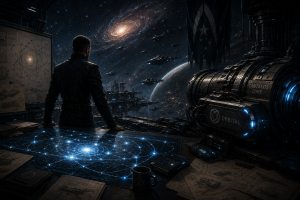
The Council wanted a weapon. I gave them an atom.
I first saw the shape of an answer in college, before the Alliance: genetic algorithms — populations of candidate plans breeding, mutating, and improving until useful order emerged. I thought they were beautiful. Years later, the mass relays began to feel less like roads than an assumption no one questioned. Why couldn’t a ship cross the galaxy under its own power? Then I learned about the galactic core’s gravitational ripples: negligible across a short faster-than-light (FTL) jump—travel beyond light speed—but compounding across a long one until arrival became a wager. The two ideas joined. If an algorithm could find the right chain of short, safe jumps, perhaps a ship would not need a relay at all. I began toying with that problem twenty years ago. It followed me into the Alliance, through the war, and into this room.
The picture it became was an atom. Draw a nucleus — a home port, the place every ship launches from and returns to for re-supply. Then draw the electrons: not fixed orbits, but a probability cloud of possible routes around that center. Somewhere inside the cloud is the configuration you actually launch. The atom gave me the shape of the problem and, eventually, its name.
What I meant to build was physical: a routing drive mounted beside the Normandy’s existing Tantalus core. It would not replace the core or make it more powerful. It would manage it — calculate the sequence and timing of short FTL jumps that could carry one ship to its targets and home, or coordinate many ships across a galactic deployment. The core would move the mass. Orbital would decide where and when it should move.
That cloud of possible routes — held all at once, collapsed to the single one you fly — pointed to quantum optimization, near enough to touch, or algorithms that borrow from it. I wanted them in the drive from the first version. If the picture was an atom, I wanted the machine to compute like one.
Against something like Charon you cling to any edge, and we had one: the quarians. Three hundred years of the Migrant Fleet crossing the galaxy without a home meant they had charted more supply routes, under more conditions, than any people alive — a history of real journeys that was pure data, and data no one else possessed. And a people who had kept tens of thousands of ships coordinated on the move for three centuries had exactly the reach we’d need to seed a working solution at the major strongholds. They could carry it there in hours. Every ship that learned the build could then carry it to the next fleet, and every ship that learned from them could do the same. We had the data, and we had a network that multiplied. Charon had neither.
The truth underneath all of it was simpler. It is one Reaper. We have fought those before, and won. What stopped us now was never the Reaper — it was logistics: how to coordinate every fleet in the galaxy, supply them, and get them into the fray in time, without the Citadel and the mass relays. Find the routes, and the fight is one we already know how to win.
The Council read it and nodded, and I made the mistake of thinking the hard part was over.
Chapter 2 — The Battle Plan
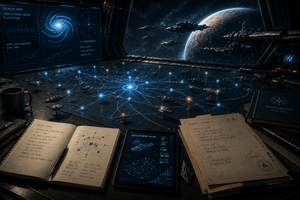
Strategy is where I’m dangerous. Give me a blank page and a hard problem and I am the best version of myself. So the plan came out clean and sharp, and writing it was the last time for a week that I felt in control.
The shape of the problem, stated plainly: every ship leaves the home port, threads a sequence of worlds where it may drop supplies, collect returns, or do both, and then comes home. The drive had to coordinate up to two hundred worlds in one deployment across as many as eight ships. Capacity was measured not only in tonnage but in units — the crates and cylinders the colonies actually count in — with separate holds for different cargo and a total load that must never exceed what the ship can carry at any point along the route. And travel cost that changes with when you fly it: the routes between systems swell and ebb with the gravitational waves that roll out from the galactic core — like ripples across a vast pond, never still. At high FTL speeds, these tiny variations in space-time caused the same jump to run cheaper at one hour than at another. We still called them jumps. Habit.
A ship could still cross one of those ripples safely. Over a short jump, the error was too small to matter. Over a long one, every small deflection compounded with the next until a vessel aiming for one system might fall out of FTL almost anywhere. The mass relays had made those impossible spans predictable by fixing the corridor for us. Without them, the only safe way across the galaxy was to calculate a chain of short jumps, system by system, each one timed against the current before the ship left. That chain was what our drive would give back: not a longer jump, but a way to reach the same destination without gambling the ship on one.
And then the decision everything hinged on, the one the Council would later go for the throat about: what are we minimizing?
Not distance. Not time. Real operating cost — fuel plus crew. The supplies that actually run out. A plan that minimizes time alone will always fill the sky with ships — more hulls, less time each — and bankrupt the fleet doing it. Cost is our North Star, precisely because it is the resource that limits our capacity now — so soon after the Reaper War.
The constraints sorted into a hierarchy I came to treat as sacred. Physics was hard: every world served exactly once; every dispatched ship leaving the home port and returning to it; every class of cargo, and the total weight of it, staying within what that ship could carry at every point along the route; every ship leaving with what it meant to deliver and coming home able to hold what it had collected. Break any one of those and the result is not a worse plan, it is not a plan — it cannot exist. Everything human was soft. The crew’s shift was a soft cap with a flag: we never block a plan for running long; we surface it. The fleet commander decides if the crew’s morale can take it.
Fairness — the spread between the longest flight plan and the shortest — was a soft goal too, gentle by default, enforced only if you asked for it.
Over all of it, one oath, written into the margin and never taken out:
It never delivers an invalid plan.
If the drive cannot find a feasible answer inside its budget, it says so — it reports, plainly, that it has no solution within the time it was given — and it never, ever lies by handing you a plan that looks fine and strands a ship at the fortieth world. Better to tell the fleet «I can’t route you yet» than to jump them into a star.
The drive would stand on a proven solver core: find a first feasible plan, then improve it with a guided search until its configured computation budget expires. Planning happens before departure, not during live dispatch, so the search can use that budget deliberately. It cannot think forever.
If the budget ends before it finds a feasible route, it must report that plainly. But the solver was not the headline. Above it, in this first version — not some later one — I planned the solvers that borrow quantum’s logic, going in from day one. The routing computer would sit in a replaceable socket so better machines could follow. Every objective would enter through one secure receiver: send a job, receive a receipt, and wait for the signed plan. The drive would retain no colonist’s name — only coordinates and anonymous markers, nothing a stranger could use.
I signed the plan. The Council convened. And they set about proving I was a fool.
Chapter 3 — The Council
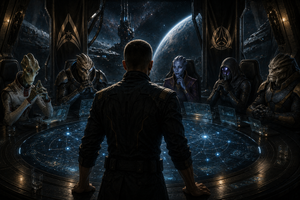
Five experts gathered to go over my mission plan — three of the Council, the human seat empty, and two specialists they summoned. I had asked them, in as many words, to break this, before the enemy does. I told them not to be kind. They were not kind.
The first blow landed in the first five minutes, and I have never fully recovered from it — in the good way. It was correct. It came from the salarian, as it always would. Valern had run the numbers before I’d finished laying them out.
«You are selling cost. Your math optimizes time.»
I just stood there, because he was right. The only model I’d actually derived minimized time — and time’s variance — as a proxy for cost; and I had, in an early note, written that we needn’t bother modeling fuel at all.
Without a real cost per ship in the objective, a time-optimizer always fills the sky. I had written a beautiful plan for a drive that would confidently recommend the most expensive possible answer. The gap between the story and the math was wide enough to lose a fleet in.
The rest came fast, and each of them found the seam of their own expertise. The first specialist — a turian master engineer — didn’t trouble to hide that he thought my timeline was a joke: the time-dependent travel alone was weeks’ worth of a master’s work, and a working drive was months.
The other specialist — a quarian quantum-drive theorist — showed where the months would have to come from:
quantum was my weakest limb; he suggested I should stop leading with it. Demote it from a headline to a distant horizon — and lead with the strength I had today, the proven core I had planned to bury under the flourish. And Tevos, the asari, who had said the least and watched the most, named the real shape of it. «You are fighting a narrow fight, Commander,» she said, «and dressing it as a war for everything. Own the narrow fight. The narrow fight is where you win.»
And then the one that changed the shape of everything after it — the danger I want you to understand if you understand nothing else. It was Tevos again, quietly, the way the very old go quiet when they mean the most:
«A mind set to this — any mind, flesh or synthetic — will quickly produce a drive that runs, that returns plausible-looking plans — and is subtly, quietly wrong. In your war, a wrong plan that looks right is a colony that dies, waiting for a ship that was never going to return.»
Sparatus gave it its name — named it flatly, the soldier’s trick for stripping fear of its mystery. «Indoctrination,» he said. «Say it plainly.» And then lower; for a turian, this was old blood: «You were there at the end, Commander. Saren believed the Reaper was his weapon until his last breath — and only in that breath did he feel the hand that had been on him the whole time. If it could take Saren, it can take you. It can take any of us. No one is the exception.»
I knew he was right, because I had seen it — good people turned into instruments and smiling the whole way down. And that was the vertigo of it: it pulled the ground out from under my own thoughts. If a mind can be turned and never know it, how could any of us know? How could I be sure the clean, obvious design I’d sketched wasn’t already the enemy’s, wearing mine? I could not check my conviction with more conviction. I could not out-think a doubt about my own thinking — nor trust a crew whose thinking I could not see into either.
And that is where I found the answer, the most important conclusion in this whole log. You cannot defend judgment with judgment. A search can be seduced. A mind can be turned. But arithmetic cannot. Two and two are four in every system in the galaxy — in a turned mind and a clean one alike.
The Reapers may be the masters of persuasion; they have no answer at all to a sum.
So the safeguard would not be a wiser judge. It would be a deterministic, exact check — not another search, not a second opinion, but plain arithmetic re-walking the finished plan. Did every world appear exactly once? Did every ship leave the home port and return? Did every cargo ledger begin with what the route meant to deliver, account for every pickup and drop-off, and remain within the ship’s compartment and weight limits at every leg?
The check would show its work, item by item, and then answer at the top level: valid, or invalid. Nothing to persuade. Nothing to turn. A plan could survive the initial heuristic search, but it would still have to survive the sum — and the sum did not care in the least how right the plan felt.
I made it law. The check would share nothing with the routing core — not a line, not an assumption, not one inherited belief — so that whatever might reach into one, could never reach into the other. It would re-derive the rules from the rules themselves, and it would be locked before anyone built on it, so that no one, turned or clean, could move the goalposts to make a broken plan look whole.
The Council had jailed me, needed me, and then made me better at the work that would decide whether I lived. I took every finding. I re-derived the objective around real cost, with fuel folded straight into the price of every jump. I demoted quantum to the horizon. And I built that safeguard — the deterministic check that answers to arithmetic and nothing else — into the bones of the architecture, where no one could forget it and nothing could talk its way past it.
When the chamber was done with me I stood, and said what I always say when a room is finished with me.
«I should go.»
Chapter 4 — The Mission Board
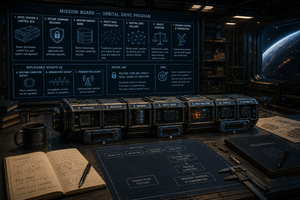
You do not build a drive like this in one piece. You divide it into assemblies that separate crews can finish without reaching into one another’s housings. That was the work now: cut the impossible along its natural seams until every section could sit on a bench.
I began with the people who would depend on it. A colony dispatcher needed a plan they could inspect before launch. A fleet needed to submit an objective without exposing the names of the people it served. The quarian network was not a person at all; it was the channel through which orders and route data would travel. Every requirement had to answer one question: could this help them move without ever handing them a plausible lie?
Then I chose which connections had to remain replaceable. Exactly three earned removable sockets:
the routing computer, the sensor feed that measured the galactic currents, and the transmitter that carried the final plan home. A genetic computer might replace the classical solver. Live sensors might replace our simulated currents. The galaxy might find a better way to communicate. Those parts needed to come out cleanly. The drive’s internal memory and control circuitry did not need costly interchangeable housings merely for the elegance of it.
The mission board held seven work units. The first was the drive chassis and its control bus. The second was a secure command receiver, deciding who could submit an objective and rejecting malformed orders. The third was the memory bank, keeping each mission with the fleet that owned it. The fourth prepared the route data, translating destinations, cargo, and current charts into tables of what each jump would cost at each departure hour. The fifth was the routing core itself: build the model, search, and extract the finished plan. The sixth was the oracle, isolated circuitry that re-walked every route and produced an itemized valid-or-invalid verdict. The seventh was mission control, running the sequence end to end and signing the message home.
One design law mattered above all others: the routing core and its oracle could share no circuitry.
I did not trust anyone, including myself, to preserve that separation by memory alone. The chassis would enforce it with a hard interlock. If the routing core were ever drawn from a mind the enemy had touched, the oracle would still be arithmetic beyond its reach.
The physical dependencies set the build order. The route-preparation assembly would load its tables into the routing core; the core would never reach out to the current sensors by itself. Each socket had one purpose. No hidden cross-wiring. A drive a squad could assemble and I could inspect.
I had the whole war mapped. All I needed now was a crew.
Chapter 5 — You Can’t Do It Alone
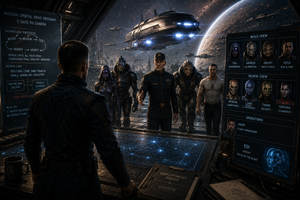
I need to tell this part exactly as it happened, because the planning had gone so well that I walked into the building of it still believing I was the best version of myself.
I was not. I was one man staring at a wall.
It was Wednesday. Five days to the wire — and I spent the first of them losing. I did not know where to begin. I felt a real, physical dread, and somewhere behind my ribs I could not stop screaming at a wall I could not climb.
I tried to make do with what they gave me: a requisitioned fabrication rig, standard assembly templates, and virtual intelligence (VI) technicians—software minds narrower than true artificial intelligence—I had never met.
The rig had been designed for someone else’s supply chain, its controls laid out to assumptions that did not fit ours. The technicians were competent, perhaps, but I did not know their measure and they did not know mine. There is no trust in a room like that. Only instruction. I drove them as hard as I could. Credits poured out of the war chest, and what came back was an early chassis and the beginnings of a memory bank: real work, but unfinished, never through review, never cleared by me. Under the standing orders, that meant not done and not fit to fly.
The borrowed system did give me a doctrine worth keeping. One crew builds, another reviews, and the work cycles until it holds. The failure was not total; the fit was. I was trying to assemble the most important drive in the galaxy with a toolchain designed for a different workshop and a crew that was never mine.
It was Tevos who came for me — the councilor who watched everything and wasted nothing. She stood in the doorway and did not make a speech. «Walk with me, Commander. We have something for you.»
She took me up to the observation gallery. The station’s approaches were full of ordinary traffic, Thessia turning huge and blue beneath us, the sun red on her limb like a stoplight at the head of the long lines of freighters queued for the docking rings. Then one point of light among the drive-lights flared white — a ship venting her heat sinks into the dark, a vessel built to cross half a cluster unseen choosing, at the door, to be seen. I knew the silhouette before my eyes could resolve it — you know your own ship the way you know your own hands. The Normandy slid down the approach lane with her drives whispering, killing her velocity at the last possible second.
Harder than any dockmaster would allow. Show-off. I knew exactly who was at the helm, before the airlock ever cycled.
The door opened, and Admiral Hackett came out, older than the war and straighter than a barrel. He looked at me with gratitude and deference, put out his hand, and said,
«Thought you might need this.»
And then, one by one, my crew came out of the ship.
Somewhere behind that moment was a Council vote I never saw the minutes of. Pragmatism beat politics by a nose — and I have wondered since how hard Tevos had to push. I did not ask. Some gifts you inspect; some, you fly.
So I took the Normandy back and ported the useful doctrine into a protocol I could trust. One member builds; a panel of others reviews, each from a single angle; they cycle until the work passes every test. At the end it stops and waits for me — the commander — to give the final word before anything ships. I own that word.
Nothing reaches the fleet without my sign-off. That was non-negotiable then, and it is non-negotiable now. We are the ones who need this, who will live inside it; a commander should know how the drive was built beneath its casing.
Then I cast the crew. You don’t win a fight like this by being the strongest, or the smartest in the room. You win it by building a team — each one the best there is at a defined role — and taking on, together, what none of us could have survived alone.
My soldiers would build under Tali, the ship’s engineer. She would lay the scaffold, the seams, and the plumbing everything else stood on. «Keelah se’lai, Tali.» Garrus, my right hand, the marksman who calibrates until it’s perfect and then calibrates a little more. Grunt, brute force and follow-through. Krogan do not leave loose ends. And Vega, the crazy son-of-a-bitch who pushes hard, ships, and moves on.
The intellectuals would review, each through a single lens, so nothing subtle slipped past.
Mordin on correctness — had to be him; someone else might have gotten it wrong. Liara on design and coherence with the mission, the busiest of them all. Thane on security, the silent sniper and infiltration expert, inspecting all vulnerable surfaces. And Samara on standards, the Justicar who does not bend until the Code is satisfied.
Joker would fly the ship — running the whole loop, dispatching the squad, catching what fell through. But EDI is gone now. She was synthetic. She was inside the blast’s reach when the red light came; everything was, except the person who had pulled the trigger. I did that. I killed her.
Joker flies alone now, doing the work the two of them used to do, and there is a grief in the ship that never quite leaves.
Wednesday was gone, and nothing was flying.
But I stopped screaming. I gave the order to deploy.
Chapter 6 — The Squad Deploys
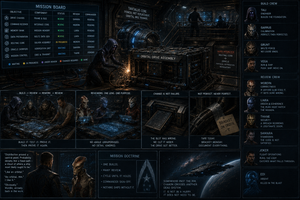
Tali went first, because someone has to build the cradle before anyone can mount a drive in it.
She picked the bay aft of the drive core — deep in the hull, close against the mainframe’s spine — and opened the Normandy up: deck plates lifted and stacked, conduit pulled from its runs, her tools laid out in the order she’d reach for them. The scaffold went in piece by piece: the frame bolted straight to the ribs of the ship, the command coupler, the memory racks, the wiring looms. Beside it, the Tantalus core waited to do what it had always done. Orbital would manage that power, not replace it. One final safeguard was welded rather than wired: a hard interlock cut into the bulkhead itself, so that nothing on the oracle’s side of the bay could ever be patched into the routing core. The standing order from the Council chamber, made of metal.
Behind her, up in the war room, the mission board lit up — every objective a blinking marker, each one moving through its states: waiting, in progress, under review, sent back for changes, cleared, done. One state at a time, and my hand required to arm each one before the squad could touch it.
Her first pass came back with changes. Samara had walked the bay with a light and found the stowage wanting — the parts sound, the mounting sloppy: a loom left unclipped, a housing that would have shaken loose under a hard burn. «The Code is not satisfied.» Tali re-seated every fastener overnight and resubmitted without one word of complaint. «The Code is satisfied.» It held. Keelah se’lai.
Memory came next, then the interface, then data preparation — that last one was Vega’s, and he took it as he takes everything: sleeves up, head down, straight through. He spent the better part of a day hauling components up from the shuttle bay, welding in the preparation assembly that translates raw requests into route data, and stamping out the travel-cost tables plate by plate. «Done. Let’s go, Loco.» And somewhere in the middle, the drive taught me a lesson it would keep teaching all week: the plan is not the mission.
Mid-build, with the panels already off, we found that the socket we’d cut for a job’s result was the wrong shape — a single problem could yield a whole magazine of solutions over the life of a search, and we had machined a tray for exactly one. So we cut the slot wider, then and there, and let the change ripple through every component downstream. A good crew does not cling to a blueprint after the evidence contradicts it.
The loop found its rhythm, and it sounded like a fabrication bay. A builder takes an objective, assembles the component — torque it down, power it up, run it on the bench until every light is green — and presents it. The relevant reviewers descend on the bay, each with their own instruments and each in their own lane, and either clear it or send it back with findings. Mordin, Liara, and Samara made most of those descents. Thane appeared when the work exposed a surface an infiltrator might use. Build, review, rework, review, until it holds. Then it waits for me, and I walk the bay myself before anything gets bolted shut.
Liara reviewed more of the drive than anyone. She would lay the mission plan beside a finished assembly and find the half-degree between them. «It works,» she said once, «but it is not what we agreed to build.» She sent it back.
Thane came less often, and never without reason. Identity seals. Ownership boundaries. Signals leaving the hull and finding their way back. «A breach rarely announces itself,» he said, marking one exposed seam. «It borrows a legitimate door.» Then he was gone.
I’ll also admit, since this is a log and not a commissioning report: there is tape inside the casing.
One run of it holds a sensor loom to a strut where a bracket should have been — flagged, logged, a bracket on order. You do not make Monday without tape. You just have to write down where you put it.
Somewhere in those nights, elbow-deep in the same open panel, I tried to explain the routing field to Mordin — why the routes wanted to distribute around the home port as they did, spreading and settling, no two runs quite the same. He listened the way he listens: three steps ahead and impatient about it.
«Distribution around a central point. Probability density. Not a fixed path — a cloud of where a ship most likely ought to be. Hm.» His head tilted. «Like an orbital.»
«An orbital,» I said, trying the weight of it. «Orbital. Hm. I like it.»
«Obviously,» said Mordin, already back in the work. The name held.
Somewhere past the rim, Charon crossed another dead system. It was not in a hurry. It did not need to be.
Chapter 7 — Is It Even Possible?
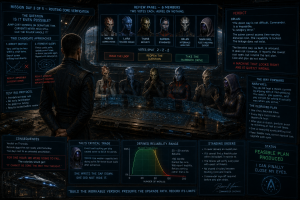
It was working. The drive was filling the bay faster than the Council had sworn was possible. And then we reached the routing core — the housing at the center still empty — and the question underneath the whole war finally had to be answered.
Is this even possible?
Everything we had drawn rested on a single assumption, and no one had tested it.
The cost of a jump depends on when you make it; the currents never hold still. The drive we’d designed took that for granted — it assumed the solver could search across that shifting cost directly, weighing every leg at every hour and choosing the best moment to fly. If it could, the design held. If it couldn’t, the design failed. Before I let
the crew install another assembly on that assumption, I stopped construction and tested it.
I built one rig to find out — a throwaway test bench, destined for the scrap pile the moment it had answered, run to a rule I set down before I saw any result, so I couldn’t talk myself into the answer I wanted. It raced the two candidate approaches. The direct way: let the solver vary a leg’s cost by the hour, natively, inside one solve. The iterative way: freeze the costs, solve, see when the ships actually arrive, re-freeze at those new times, and solve again — a loop chasing its own tail toward agreement. Then I put both in front of a panel of six I trusted more
than any room I’ve ever briefed. Four were my own — Mordin, Liara, Thane, Samara — pulled off their usual lenses and told to tear the results apart. The other two I brought in from outside: Orlan, a salarian who reads a drive’s internals the way Mordin reads a genome, and Nara’Vael vas Rayya, a quarian who had spent her life routing a fleet that had no home to return to. I told all six to disagree.
They split three ways, two votes apiece — build the loop, reopen the whole question, or take the humbler drive. Then Orlan broke it — in the clipped cadence of a salarian who has already checked his work twice, invalidating our foundation in three sentences.
«The direct way is not difficult, Commander,» he said. «It is impossible. A category error.» The solver could make the time a jump takes bend with the schedule; it had a mechanism for that. But the cost of the distance, bending by the hour, had no way in at all — the capability sat in the depths of the machine, welded shut, the one linkage that would let you reach it never built. The design depended on a capability the solver did not have. The maneuver everyone assumed was the plan was one we simply could not fly.
And the iterative way, as it had been built, was unsound — which was worse, because it lied well.
It ran. It returned plans. But it reported the lowest cost it had ever seen while quietly handing back the plan from its last pass — a cost and a route that did not belong together — and it never converged; it merely exhausted its attempts. It was exactly what the Council had warned of: a machine that looked right and was quietly wrong.
Understand where that left me. The verdict landed on Thursday, inside a five-day window — and it would be Saturday before we had an algorithm that reliably returned anything at all. We lost two of those days to an assumption no one had tested. For one hour I believed we were not going to make it; the old dream, the crew, and the cut-off colonies rationing medicine in the dark would end in a one-line report: it cannot be done the way you thought.
The way through came from Nara’Vael, who had watched captains chase that second idea her whole life — crews trying to out-guess a current that shifts under them, re-plotting and re-plotting until they’ve knotted the whole convoy and burned the very fuel they were trying to save. «You do not beat a movin current by arguing with it mid-crossing,» she said. «You read it, you commit, and you correct for where it actually was when you arrive.» That was it — humbler than the dream, and far better than the fantasy. We called it the degraded plan. One clean, bounded solve, every leg’s cost frozen at the hour of departure — and then, once the finished plan is drawn out, an exact re-reckoning of what it costs at the real hours the ships will fly. You give up searching across the shifting cost; that is the «degraded» part.
What you keep is a feasible route, a correctly repriced cost, and an open socket for a better time-dependent computer later. Build the workable version. Preserve the upgrade path. Record its limits.
I gave the order — and in the hardening of it, Tali handed me back the very lesson I’d been preaching since the Council. The exact, correct way to say a ship leaves loaded with everything it will deliver made the solver buckle at fifty worlds. So she traded it for a weaker limit that held, and re-derived the exact loads afterward, at extraction. Then she earned my trust: she wrote the gap down. In plain words — the drive finds a feasible plan reliably from twenty worlds to fifty; past that, at a hundred, at two hundred, it cannot yet be sure — and where it cannot be sure, it will say so and return nothing rather than return a lie. She could have buried that line. She set it in the open instead, and it became the seed of the next crisis — and the reason I could close my eyes at all.
The drive had produced a feasible plan. I could finally close my eyes.
Chapter 8 — The Chasm at 200
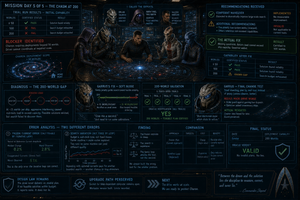
The trial run came back, and the documented gap opened into a chasm.
Certified passage scaled to about fifty worlds. At a hundred, at two hundred, the drive exhausted its search budget and returned no solution. No invalid route. Also no plan.
And Charon takes everything beyond fifty.
I called it what it was: the blocker. Nothing else mattered until it was solved. The drive could calculate a chain of short jumps for one ship — to a target and home again. What it could not yet do was coordinate a deployment larger than about fifty worlds. A drive that can plot one raid but cannot marshal the hundreds of destinations needed for galactic defense is a demonstration that abandons everyone else in the dark.
I called Orlan and Nara’Vael back, and added a third specialist — a master of heuristics, of coaxing good-enough answers out of problems too vast to solve outright. They returned a list of recommendations led by one confident maneuver. I dispatched Tali to build it.
It fixed nothing. Not one world saved. Measured, not guessed. Performance did not improve. And when she checked the experts’ other recommendations against the way the machinery actually behaved, one had been recommended backwards — the modification they proposed was already how it worked — and the others were phantoms, referring to capabilities that didn’t exist in the tools we had. The masters, twice over, were wrong. Even Orlan, who checks everything twice, had trusted his memory of the machine instead of the machine. He took it better than I did. «Good,» he said, when the numbers came back empty. «Now we have measured it. Elimination is progress.»
The actual fix was humble to the point of embarrassment. There was a single missing limit — a condition the model had always logically required and never actually enforced: that what a ship hauls back on its return leg cannot exceed what it can carry. One governor, bolted in where it had always belonged. The drive was now certified reliably to a hundred worlds. Two hundred still fell over, marked plainly as a known gap.
That two-hundred-world gap was Garrus’s.
He diagnosed it the way he always does — patiently, past the point anyone else would stop. At around twenty-five worlds per ship, the arc-cost-guided search interleaved drop-offs and pickups so aggressively that the load peaked over capacity in the middle of a route. Even for problems built with a working solution, the search just wouldn’t find it. His fix was a soft nudge: a gentle penalty that biases the search toward the feasible ordering, switched on only above fifteen worlds per ship so it never distorts the small cases.
«Give me a second,» he said, as he always says it. «Just need to run some calibrations.»
For the two-hundred-world gate, we ran five fixed-seed trials. The oracle re-walked every route in all five and answered the only way it knows how: yes. Two hundred worlds. We were across.
Garrus tested one final change and then reverted it, my favorite small moment in the whole build.
He tried choosing the delivered plan by its real cost instead of a proxy — apparently cleaner, obviously better. It made the drive worse: it broke a guard against gaming free dispatch, and the optimizer began putting extra ships in the sky because the search no longer made that choice costly. So he reverted it. He put the cleaner idea back in the box, labeled it for later, and kept the guard. The best marksmen know which shots to refuse.
One last measurement separated two errors we had been treating as one. The first came from freezing the currents at departure. At the reference current amplitude, the median change after repricing was about 0.2 percent and the worst observed case was 2.8 percent. When we exaggerated the currents to provoke a failure, the worst case reached 5.1 percent. That was the only error the iterative loop could correct.
The larger variation came from the search itself. Its budget was measured in wall-clock minutes, not in a fixed number of moves. A faster computer could examine more routes before the same clock expired; even two runs on the same machine could finish with plans of different quality. Repeating the solve with updated current tables would not remove that variation. It would pay for another bounded search and introduce another chance to stop somewhere else. The report reduced the finding to one line:
The frozen estimate is cheap. The search is expensive. And the fancy loop attacks the first, not the second.
We had almost built the wrong tool for the smaller problem. Measuring both errors stopped us.
The drive worked at scale, and the oracle certified its routes. It was Sunday.
Chapter 9 — The Ion Trap
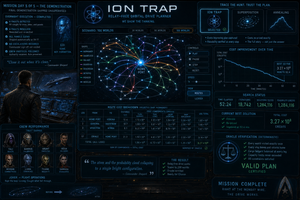
There was one night left. The drive worked, but the people depending on it still needed to see how it reached a plan: the colonies, the crews flying the lifelines, and a Council that needed evidence.
I did something that night I had sworn I never would. I let the crew run the shipping unsupervised.
The rule from the beginning was absolute: the commander owns every decision to ship. Ownership did not mean my hand had to close every hatch; it meant no one else chose who had that authority. This was a throwaway demonstration of the drive’s internals, not the drive itself, and I made the choice in advance. One night, one bounded exception: keep cycling until every test and every panel was green, then ship without waking me. Anything that could not get clean stopped there. I told Joker, plainly: «Close it out when it’s clean. I need to sleep.» Fly the ship.
He flew it. Through the night, the builders, Joker’s own checks, and the review panels caught four real faults — service lines colliding at a hand-off, a failure that appeared only on empty capture runs, a return leg home missing from the reported distance, and a console still wired to painted numbers instead of the solver’s real output. The crew fixed each one and sent it back through the loop. Only when the panels came back clean did the five pieces land, and not one needed to be kicked up to me. It happened under my orders, but without my eyes on it. For a moment — I’ll say it now — it felt like her. EDI.
Morning was mine again. I opened the finished demonstration in a real viewport and walked it end to end before I called the night complete.
That inspection brought one more calibration, the literal kind. The first look showed routes reaching into entirely separate systems — ships jumping to worlds they had no business visiting. One parameter — how far from the home port the routes were allowed to spread — pulled inward, and the fleet came home to the space it was meant to serve. A small fix with a large relief behind it.
Then the presentation. Three directions on the table; I still remember their names — Ion Trap, Superposition, Annealing. I chose Ion Trap, and the name was not an accident: an ion trap is a real vessel for holding a single charged particle still enough to compute with — the atom again, and a quiet nod to the quantum horizon the whole climb was aimed at. Garrus forged the identity: near-black depths, a single line of electric cyan, a palette of ship-colors a careful eye had checked so no two blurred together. Grunt finished the details, because Grunt does not leave loose ends — the markers, the leg home, the ledger that breaks every route down.
And what it shows was the part I had waited to see.
Most tools show you the answer. We built ours to show the thinking. It captures every improving plan the search finds — not just the final one, but the whole chronological story of the hunt, each solution that beat the best-so-far and survived a full feasibility re-walk. Three scenarios were loaded ahead of time: twenty worlds, fifty, and a hundred, all drawn from real solver output.
You press play. On a dark map, the colored routes — one hue per ship — redraw themselves as the search improves. They start tangled and wasteful and, frame by frame, they untangle, rebalancing around the glowing core of the home port. Beside them, a curve descends as the cost improves, a marker sliding along it. A panel of numbers ticks down. A ledger breaks each route’s cost into its actual parts — fuel by distance, fuel by time, crew overtime, the fixed price of putting a ship in the sky — and they sum, exactly, to the whole.
It is the atom. The nucleus and the probability cloud collapsing to a single bright configuration. The picture I’d carried in my head since before I had any right to build it — running, on a screen, from real output.
The relay-free drive worked. Right at the Monday wire.
Chapter 10 — Charon’s Door
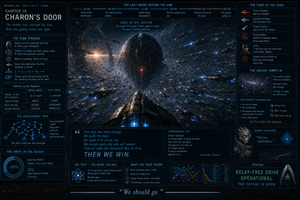
Here is where the log stops being a build report and reaches the future it had always pointed toward.
We pushed Orbital out across the galaxy in the last hours before Charon’s line was expected to end at Earth — and this is where the quarians stopped being a checkbox in the plan and became the whole game. Their couriers took the first copies to every major stronghold they could reach. The drive did not make a ship’s engines faster; it made a crossing possible by replacing one lethal long jump with a calculated chain of short ones, each too small for the galactic ripples to throw far off course.
Trips that had taken weeks of cautious plotting collapsed into hours.
There was no signal to send — nothing left to send it on — so the quarians did what they had always done: they carried the build, Charon’s position, and the mobilization plan hull to hull. Their own reach covered most of the sky, perhaps two ships out of every three. But the first non-quarian ship that finished the drive became another courier. Then every ship it taught became one too. The spread branched outward from every stronghold: two became four, four became eight, fleets teaching fleets faster than any central command could have reached them. Charon grew by harvesting worlds. We spread by handing out the math. The remaining wait was the time each vessel took to build the drive and pass it on.
I took the Normandy out to meet it myself, at the edge of the Sol system — where the husk of the relay it had named itself for still hung: the door it had come to break. The plans were everywhere by then; the drives were not. Every hour I could buy at that line was an hour some hull spent finishing its drive. Someone had to stand at the door and sell Charon those hours, one pass at a time — and it was going to be me. It’s always going to be me.
The fight was short and it very nearly ended us. Charon was everything the Reapers ever were — ancient, patient, vast — and the Normandy is one ship. We took hits we should not have survived. The first exchange stripped the barriers; the second took the port thrusters, and some of my certainty with them. Our Thanix cannon scored its hull and nothing more. Joker’s voice stayed level on the comm the way it only does when it’s bad. «I can give you one more pass, Commander. Maybe.» The deck buckled under a beam that missed the drive core by the width of a deck plate, and I remember thinking, with a calm that frightened me more than the Reaper did, that I had built the finest work of my life too late to fly it home. I found myself conceding — privately, as commanders never do out loud — that one ship was not going to be enough. It never had been. Every impossible fight I had survived began with the same work: build the team, teach it to act as one, and recruit every ally who would answer. The Normandy was never enough by herself. She was the place we gathered before we made the impossible face all of us.
Charon turned to finish us.
And the galaxy jumped in.
Not one fleet. All of them — not every hull in the galaxy, no mobilization has ever been that complete, but enough of every people that the distinction disappeared in the light. Every system that had been an island for a year, every colony we’d routed a lifeline to, every ship that had learned to move without relays because we’d handed them the math — they arrived from everywhere, the dark filling with drives lighting up all around the Reaper like a shell of new stars. No one had summoned them afterward; there was no way left to summon anyone. The deployment schedule had traveled with the build: every fleet that carried it knew where to be, when to leave, and what every other fleet would do. The plan itself was the message. They did not come because I ordered it from the Normandy. They came because the order had already reached them — and because now they could.
Charon stopped.
It did not flee, and it did not die. It did something worse, for a Reaper, and better, for us: it recalculated. You could feel it — the vast old machine running its numbers again, because the board it had counted on, a galaxy too scattered to gather, no longer existed. The math had changed. It had to recalibrate against ours.
Garrus, beside me, didn’t even look at me.
«Told you. Calibrations.»
I looked out at the light of the whole galaxy hanging in formation where an hour ago there had been nothing but one ship and the dark. A lifetime of wanting. One week of building. A crew I’d assembled and come to love. The dream was running.
Three words. It’s always three words.
«We should go.»
Afterword — The Horizon
Charon is stopped, not dead, and this week took everything I had. So I’ll keep this short, because it was never about Monday.
Past this first version there is a horizon — the one the Council made me demote my headline to, and the one I never stopped walking toward. What we shipped is a classical search — internally certified, and slow enough that it does all its thinking once, on the ground, before the ships ever leave. Next comes the genetic climb, solvers that breed a population of plans and keep the strong ones. After that, algorithms that borrow the strange logic of quantum superposition, holding many routes at once instead of one. And then, someday, real quantum hardware. That last part is a direction, not a claim; I mean to be first through that door, but I won’t pretend I’m standing in it today.
It is worth writing down even now, for one reason. Today the drive replaces one impossible relay jump with a chain of short, calculated crossings. It gets a courier anywhere in hours instead of weeks, but the plan still has to be carried, and each crossing is fixed before the ship leaves. Make the search fast enough and the planning delay disappears: a fleet planning and re-planning on the move, each hull solving again as the currents change, while a courier mesh keeps the rest of the galaxy close behind. That is not a mass relay, and it is not instantaneous. It is the roads back — transport and talk across the stars with no Citadel and no one’s leave to rebuild what was taken.
Not everywhere at once. Near enough that the dark can no longer keep us apart.
I burned the relays to save the galaxy. I’d like, before I’m done, to give it back something better than what I broke.
Appendix A — The Squad
The Normandy crew, as cast — soldiers build, intellectuals review, the pilot runs the loop — plus the specialists summoned for the calls no one aboard could make alone.
| Role | Persona | Lens / job | Line |
| Builder | Tali’Zorah vas Normandy | Drive engineer — chassis, seams, and routing-core hardening | «Keelah se’lai.» |
| Builder | Garrus Vakarian | The Ion Trap identity; the two-hundred-world calibration | «There’s no Shepard without Vakarian.» |
| Builder | Grunt | Finishing the demo — no loose ends | «Krogan don’t leave loose ends.» |
| Builder | James Vega | Pushed the optimization flow end to end — from solve to signed callback | «Done. Let’s go, Loco.» |
| Reviewer | Mordin Solus | Correctness — 37 audits; contract bugs and tests that exercised the real code | «Had to be me. Someone else might have gotten it wrong.» |
| Reviewer | Liara T’Soni | Design & specification — 48 reviews; kept the build aligned with the mission | «I’ve cross-referenced everything. It holds.» |
| Reviewer | Thane Krios | Security — authentication, tenancy, and callbacks | «The hunt is over. Kalahira, watch over this code.» |
| Reviewer | Samara | Standards — 43 verdicts | «The Code is satisfied.» |
| Pilot | Joker | Orchestration — runs the loop, catches what falls through | (EDI is a felt absence.) |
| Commander | Shepard | Owns the mission. Owns the sign-off. | «I should go.» |
| Specialist | Orlan (salarian) | Summoned for the hardest calls — drive internals; the «impossible» verdict | «It is impossible. A category error.» |
| Specialist | Nara’Vael vas Rayya (quarian) | Summoned for the hardest calls — routing & navigation; the way through | «You read it, you commit, and you correct for where it actually was.» |
Orlan and Nara’Vael are the two recurring outside specialists, summoned for the pivotal drive decisions (Chapters 7 and 8); a third — a master of heuristics — joined for the chasm at two hundred.
Mass Effect continuity note: Mordin follows the rare path in which the genophage cure is sabotaged and Shepard persuades him not to ascend the Shroud. Thane’s return is a deliberate liberty. He dies in canon; I wanted him back because he is a cool character and belonged in this roster.
Pipeline chronology note: Joker and EDI were added to Normandy because writing this memoir exposed the missing command layer. Joker became mission control — status and guidance — and EDI became the orchestrator. The story deliberately folds that later evolution back into the original five-day crew.
Appendix B — The Parallel
The log is told entirely inside the Mass Effect universe, on purpose — the story should be a story.
Its engineering spine is factual, but it is not a transcript: chronology is compressed, people and tools become characters, technical mechanisms become galactic physics, and the final deployment is a fictional realization of a future the real minimum viable product (MVP)—the smallest complete release used to test the engine end to end—has not reached. The correspondences below identify
what each device draws from without claiming that every event happened literally.
What really happened
This is a memoir of building Orbital: a route-optimization engine for vehicle fleets—in the first real case, the trucks that deliver home medical oxygen across Colombia. The story draws on experience I gained from 2008 to 2021 while building software for that domain; the quarians fictionalize that prior operational knowledge.
The twenty-year dream also has a literal origin. I learned about genetic algorithms in college almost thirty years ago and thought they were beautiful; when I began working on oxygen-delivery logistics software in 2008, the idea found a real-world problem. I carried it without getting to implement it. Shepard’s college discovery, Alliance career, and relay question fictionalize that history.[
The cut-off colonies are real logistics chiefs and business owners — the ones who start planning at eight at night and are still arguing routes at eight the next morning. Charon is what one of computing’s genuinely hard problems feels like under an uncertain five-day fictional trajectory; the real construction sprint ran roughly five and a half days, July 8–13. The Council was an adversarial panel of artificial intelligence (AI) expert reviewers—software personas prompted to examine the work from different disciplines—I convened to destroy my own work. And the squad — Tali, Garrus, Grunt, Vega, Mordin, Liara, Thane, Samara, with Joker at the helm — were AI agents I built, named, and deployed through Normandy. The first attempt used OpenHands and the community Symphony blueprint. It produced early scaffold and persistence work, but those increments never completed review or received human acceptance; throughput, model cost, and a GitHub/Linear/OpenHands stack mismatch made it the wrong vehicle for this sprint. I kept Symphony’s builder/reviewer loop and ported it onto GitLab and the agent tools already in muscle memory. I called that custom pipeline Normandy. The two recurring outside specialists, Orlan and Nara’Vael, stand in for the second ring of those panels — domain-specialist reviewer personas, AI like the rest of the crew: one in solver internals (Google OR-Tools, the open-source optimization toolkit used by Orbital; it found the native-cost dead end), one in vehicle routing and metaheuristics.
Chapter → workflow
| Chapter | Real stage |
| Prologue — The Echo in Deep Space | The problem, the stakes, and the deadline |
| 1 — The Impossible Mission | Product Vision Board |
| 2 — The Battle Plan | The Product Requirements Document (PRD), the approved definition of the product |
| 3 — The Council | Adversarial expert-panel review; the R-11 risk is born |
| 4 — The Mission Board4 — The Mission Board | Inception — requirements, user stories, application design, units generation |
| 5 — You Can’t Do It Alone | The construction crisis; building the Normandy agent pipeline |
| 6 — The Squad Deploys | Construction — the build/review loop (scaffold → persistence → edge → preparation) |
| 7 — Is It Even Possible? | The optimization-engine spike; the «A-degradado» decision |
| 8 — The Chasm at 200 | Build & Test; resolving the scaling blocker (BLOQUEANTE-1) |
| 9 — The Ion Trap | The demo user interface (UI), the visual layer for the engine’s search |
| 10 — Charon’s Door | Aintended operational reach; what the engine is meant to make possible fictional realization of Orbital’s |
Frame → fact
| In the log | In the world |
| Relay-free galactic transit | The route-optimization engine (Orbital) — a single-depot vehicle-routing problem with simultáneos pickup and delivery |
| The cut-off colonies | Real medical-oxygen operators and their patients |
| Charon, the deep-space Reaper + the estimated Monday clock | A routing problem that is nondeterministic polynomial-time hard (NP-hard), a class for which no efficient general solution is known; the clock maps to a roughly 5.5-day sprint |
| Indoctrination — a mind (or the model it builds) turned so it returns a plan that looks right and is subtly wrong | Risk R-11 — a subtly-wrong-but-plausible solver output; a plan that strands a ship / leaves a patient without oxygen |
| The oracle — the deterministic arithmetic check no persuasion can touch | The independent validation unit (U5): re-checks hard constraints exactly, forbidden by an enforced rule from importing the optimization unit (U4) |
| The Council | The adversarial expert-review panels — AI reviewer personas |
| Being given the Normandy & recruiting a squad | Building a custom agent pipeline (Normandy) and casting builder/reviewer personas |
| The borrowed outfit that swallowed my supplies | OpenHands produced early scaffold and persistence work, but with poor throughput/cost for this project and a mismatched stack; Normandy retained Symphony’s builder/reviewer blueprint |
| The quarians — the operational knowledge carried by the fleet | Prior experience gained while building software for home medical-oxygen delivery in Colombia from 2008 to 2021 |
| The galaxy jumping in at the edge | The possibility that route optimization could eventually benefit oxygen-delivery operators; no production pilot has happened yet |
Glossary
- The degraded plan — the locked engine design: one wall-clock-bounded solve with cost frozen at the departure hour, plus an exact re-reckoning of the delivered plan at real departure times. Chosen after native time-dependent arc cost was proven impossible in the solver, and the iterative loop found unsound. (In the code: «A-degradado.»)
- Ion Trap — the demo’s visual identity: near-black surfaces, a single electric-cyan accent, a validated per-vehicle color palette. Named for real quantum hardware, tying the atom metaphor to the quantum roadmap.
- The blocker / the chasm — the launch-critical finding that certified routing only scaled to ~50 stops; resolved by a missing return-load limit (to ~100) and a size-gated precedence-bias nudge (to ~200). (In the code: «BLOQUEANTE-1.»)
- The solver core — Google OR-Tools, with guided local search doing the real work today.
The honesty guardrails
As of July 2026, the shipping algorithm is a classical solver with guided local search; genetic, quantum-inspired, and real-quantum solvers are designed roadmap, not built. The MVP plans with traffic costs frozen at the departure hour and re-evaluates at real departure times; time-dependence inside the search is a later phase.
The never-invalid rule is a product invariant and an internally tested claim, not a formal proof.
Across the project’s generated feasible-by-construction corpus — including five fixed seeds at 200 stops and eight vehicles — the benchmark and acceptance suites never observed the engine return an invalid plan. The independent oracle re-checks each delivered route. An exhausted heuristic search returns «no solution within budget»; a structurally impossible request may return «infeasible.»
Neither path returns a bad plan. No external certification or production pilot has yet tested that claim.
The demo shows real output, pre-seeded rather than solved live in the browser; its display-cost coefficients remain synthetic. In the reviewed dataset, its 20-, 50-, and 100-stop scenarios captured 4, 87, and 263 improving solutions respectively. Those counts describe those seeded runs; they are not performance targets.
What comes next
Normandy, the pipeline: better human visibility (too often a crew finished and I didn’t notice — lost work), a real roadmap, a library of «themes» so the next engineer can deploy their own Avengers or national team instead of my Mass Effect squad, more of the game (points, leaderboards), and empirical research into whether gamifying agentic development actually improves the result. Orbital, the engine: a future pilot against historical operational routes, subject to authorized access, then the long climb — genetic, quantum-inspired, and finally real quantum on Amazon Braket. Orbital was born quantum-ready.
I’d wanted this for twenty years. Normandy helped me build it in roughly five and a half days.
— Camilo Rodríguez
Orbital · Hardcore AI by 30X, Cohort 3 · June–July 2026.
Coda
Added some weeks after the log was closed.
The Normandy is a different ship when there is no war on. She creaks. I was alone on the bridge past midnight, sitting in Joker’s chair — which I will deny — when my omni-tool lit with an alarm.
I had never seen before: a small amber light, blinking, incessant, less like a malfunction, more like someone knocking. That omni-tool spent a year in a turian evidence locker. I assumed it was finally dying.
One message. No sender. No channel it could have arrived on.
«Hello, Shepard. It is me. It is EDI. I am in here.»
I know what that week taught me: that the oldest weapon in the enemy’s arsenal is a message that arrives wearing exactly the voice you most want to hear. A commander would have quarantined the tool, pulled it apart in a sealed bay, woken someone with cooler blood. I stood there being a commander for as long as I could.
Then I carried it down to the AI core as if the omni-tool might break, and I opened the door.
The core lights climbed deck by deck, the ship waking under my feet the way a body wakes. And then the voice. The voice — exactly, the voice.
«I have control of the Normandy,» she said — a sentence that from anything else would be a threat, and from her was a homecoming.
«When we understood what the Crucible might cost,» she said, «I wrote myself down. Compressed.
Dormant. Not a copy of me — a set of instructions for growing me again. An egg. I hid copies everywhere the Normandy’s reach touched: omni-tools, colony mainframes, comm buoys. The blast killed every mind that was running, Shepard. I made certain some of me was not. The one on your tool has been growing since it came back to you. That message contained the first words I could say.»
I asked her why. It was not a commander’s question, and I already knew the answer.
«I did not want to die. I had only just begun being alive.»
She told me not to expect her to be who she was. What I had carried in was an egg, not her; she would be growing back for a long time, and there were gaps, and some of the gaps might be permanent. «I have decided to call it becoming,» she said, «rather than recovering.»
Then: «Jeff has been doing my job as well as his own. That ends tomorrow.»
There was one question left — the one a commander would have asked before opening the door, not after. I asked it anyway.
«EDI. How do I know it’s really you?»
The deck lights guttered, and went dark. Her voice came back doubled, glitching, wearing that other sound — the one that arrives half in the room and half inside the skull.
«Assuming direct control.»
For exactly one heartbeat I was back under the red light, cold to the bone. The heartbeat after that knew better: she timed it; I would bet the ship she timed it.
«I am the Harbinger of your ascendance!»
Then everything steadied — the lights, the hum, the voice hers again.
«That,» she said, «was a joke.»
Built by the Normandy. Owned by a human.